Tuesday, July 26, 2011

26 July - final workshop


This morning we had 48 participants as we continued to explain the principles of the Unity Project and hold more group exercises. We began just before 10 and went until about 3pm, finishing with the organizations explaining their strengths, challenges, and opportunities. We asked them to continue with the exercises, extending them to their entire organizations and to determine one challenge to focus on for the next three months. We explained that these two meetings were more of an orientation to the UP and that more in-depth trainings will begin when we return. It was a very productive meeting. We have many partners already - Children of Hope Uganda,the Barlonya School, Alternatives to Violence (AVCOH), St. Katherine's School for girls, Rachele Secondary School, Friedi's Rehabilitation Center, Te-Cwoa, and one more - a counseling center that is based at Rachele. It is far more than we hoped for, and it shows us how excited the organizations and schools are to work together. Everyone in attendance was so warm and inviting.

One more meeting tomorrow, and we will return to Kampala.

25 July - Many meetings!


Our morning started at Rachele Secondary School, a school that began as a rehabilitation Centre during the war. The principal brought together a couple teachers and staff to meet as he described the history of Rachele and we talked about ways in which the Unity Project might be of assistance. It went very well!


From there we went to AVCOH, an NGO that works on gender-based violence, HIV/AIDS training and support, and water issues. Most of the staff are volunteer (if not all). What big hearts they have - all the time they put in when they must be in need of making money for themselves. Some of the stories, circumstances, and statistics they gave us regarding the sex trade, unwanted children, HIV testing, and water issues made me cry. Most of these terrible conditions are linked to the abject poverty many people in the area live with. Education is needed, but there must also be conditions that permit parents to value education and their children (especially the girls)and for them to afford fees along with the basics of housing, food, and sanitation.


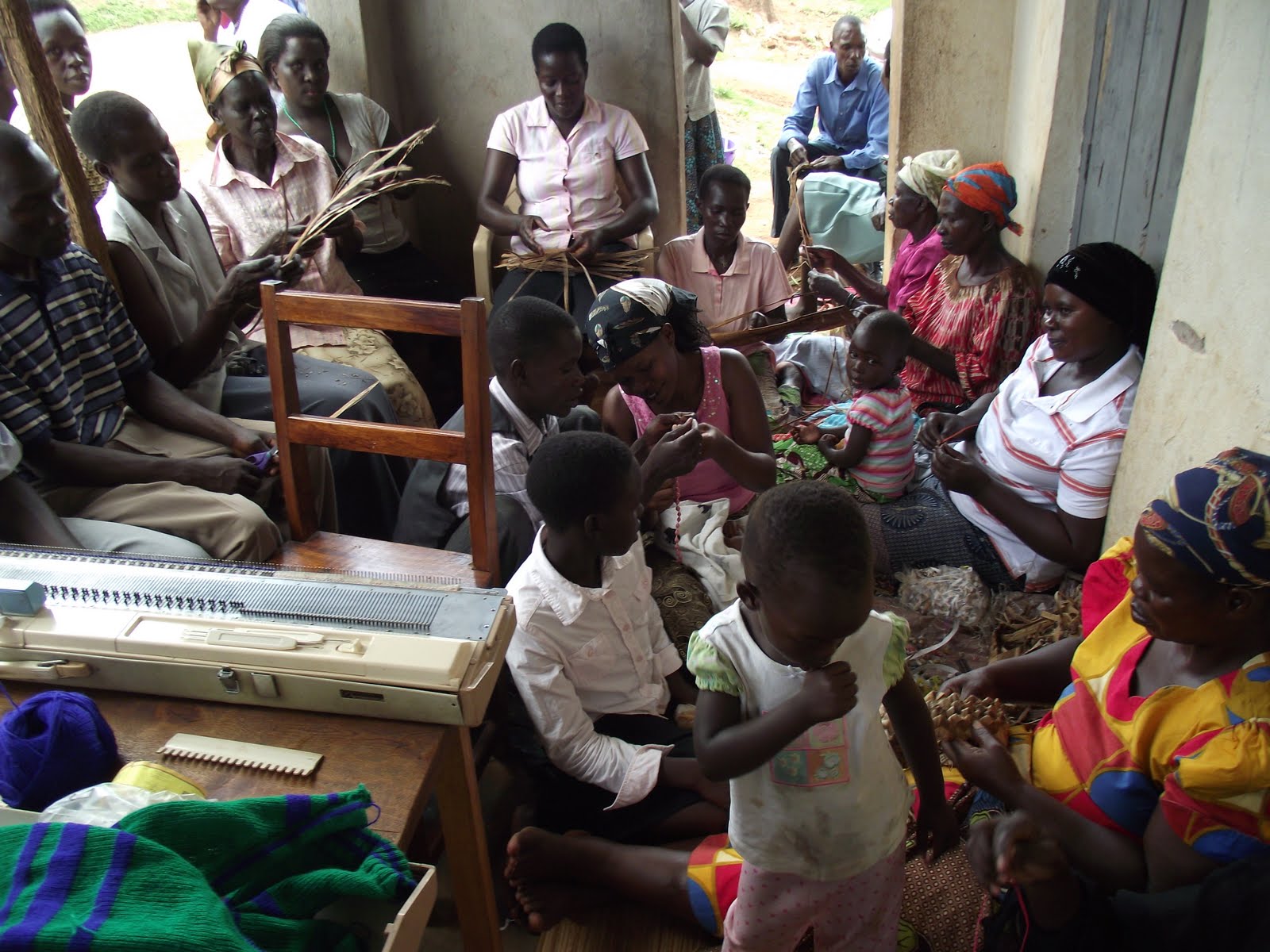
Next we went to Te-Cwao, where the women greeted us with ululations and song. What a welcome! There we talked with Ester and the director about this CBO's history and purpose. Similar to COHU, it is to support local people with their hanidwork as well as returned children. Their work is beautiful, but there is little market in Lira. We hope to help the organization with selling their work online and/or in the US. We watched the women and a couple men as they rolled and strung paper beads, woven baskets, and wove purses out of banana leaves. Nearby is an IDP camp, mostly emptied now, but with a few families still there. Abject poverty comes to mind.


Our last meeting was at St. Katherine's Secondary School for Girls. We met with Emma, a teacher and counselor, who told us that of the school's 1000 girls, near 200 were former abducted girls. She said that psycho-social issues, parents, early pregancy, and HIV/AIDS were among the challenges faced by the school. We attended an assembly of all the girls after and spoke briefly to them. They presented a skit about being a good friend and HIV/AIDS prevention as well as a news report. We invited Emma to attend our workshop tomorrow.

We are learning so much it is hard to process it all. Thank goodness for storage devices like digital recorders, cameras, and videos.

Sunday, July 24, 2011

24 Sunday - Radio Wa and Teens Magazine


Back to work! At 10, Martin (whom we have nicknamed “dogola,” Lao for “the doorway,” as he has made sure we get where we need to be, have materials we need, brings together our partners, etc., etc.) had his parents meet us at the hotel. They bicycled 20 kilometres from their village just to meet us! They were such gracious people. Martin also invited a friend of his, named Emma. Who is a counselor at St. Katherine’s School for Girls. It was the place where I had my bests intereviews with students in November, so we were thrilled to meet her. She invited us to an assembly at the school on Monday afternoon, so one more appointment to squeeze in!


From there we went to Radio Wa to meet with Emmanuel (also called Emma). He and a group of volunteers are doing wonderful work at schools and with drop outs with presentations about social skills. We showed us the development plan for his work. He also creates a bi-weekly program for the radio which is produced in the native language. He called it a “radio soap,” in which he and his volunteers put on a verbal skit about some social issue, then invite comment from listeners. Emma mentioned that violence, teen sex and pregnancy, HIV, and drugs/alcohol are all problems among youth. About 30-40% of children/young people are not in school for various reasons.

Emma lives on 150,000 Ugandan shillings/month (about $40 US). He is very intelligent. He had only one semester of university before his support dried up. He told us that he decided if he could not attend university, he could return to Lira and give back to his community. Emma’s parents died when he was young, and he was raised by people in the community.

So many pieces are coming together , fitting perfectly into a Unity Project. It’s more than we hoped for. Next week is also jam packed with meetings, another workshop, and presentations. We need more time!!

Fortunately, we did not have afternoon meetings scheduled, so we are now at Sankofa trying to catch everything up before we hit the ground running on Monday. Funny note inside the bathroom door: I’m sure it is meant to be “Push door and lock.” It says, however, “Push door, and luck.” Indeed!!

23 July - Murchison Falls Game Reserve


Martin and Solomon wanted to take us to Murchison Falls Game Park today. It was wonderful, but also very tiring, as we were away for about 15 hours. We drove through the south entrance of the park which is heavily forested. There we saw lots of baboons. There are also opportunities to trek for chimpanzees (we did not have time). We drove to the top of Murchison Falls) – it is probably the most powerful falls I have ever seen. Then we took the ferry over the Victoria Nile to the north side of the park (Paraa). We ate at the lodge were I stayed in November, then found a game trekker to ride with us to find animals. We saw many giraffes, some elephants, water buck, Jackson’s herdabeasts, kobs, hippos, water buffalo, wart hogs, jackals, and beautiful birds. As we traveled, we got to know more about each other and talked about the workshop and more details of our project.

22 July - Unity workshop


We were up and prepared to begin our morning workshop at the facilities at the hotel at 9am. We also need to adjust to African time. 9am means 10 or so. We originally expected 10-15 participants. 44 showed up from all the organizations we are beginning our work with! It was terrific. John explained the origins and underpinnings of the Unity Project. We have already seen how it fits into Lira over the past two days of meetings. There was great consensus among the participants that this would be an important project for the community. They are all doing such good work, and we have a few elements that we believe can help students and adults by using experiential exercises and problem solving groups of student action groups forming a Unity Council, and adults as a Unity Assembly to help support the children’s work. John, in particular, is brainstorming connections and ways in which to market the community goods for the members to increase their financial security.

After our tea break, we did a couple exercises with the group to help them recognize their own strengths, both individual and community. John has said a number of times, “There is nothing wrong with Uganda that cannot be fixed by what is right with Uganda.” We are intent on helping the community recognize the richness within it to solve its problems together.

Mid-afternoon, we came to Sankova Café (where we can use the internet) and got some work done. We also briefly met Eunice, whose program with women and children we will visit on Tuesday afternoon. I also met her in November 2010. It was a long, but exciting day.

21 July - COHU and the Barlonya school


Today was such a moving day. We began at the COHU office, meeting Esther and Solomon. Esther told us about the beginnings of COHU, under a tree, with no building or resources. She had been an elementary school teacher, but after the war, she just wanted to find a way to help the children and women who were so affected by the war. COHU now has many programs that help the children and widows. The grandmothers received training to make beads, baskets, toy animals, and clothing. They sell the products to receive money to support themselves and orphan children they agree to take in. some also receive seeds or livestock or ox plows to support themselves in exchange for supporting the children of COHU. Esther showed us a project she did with the children in which they drew pictures of before and after being supported by the women and/or the Barlonya School. The before pictures are filled with guns, soldiers, hangings, fighting, coffins. The after are happy pictures.

We then traveled to Barlonya, the site of the largest massacre of the war. It was an IDP camp, and the rebels entered on Jul 27, 2006(?) in the evening. It was a day of a national holiday, so all the village was celebrating. Rebels forced over 300 people into the huts and burned them alive, forcing the rest of the village to watch. They also killed people with machetes. There is a memorial there (though the number of those killed is inaccurate, at just over 100). The caretaker of the memorial said that bones are still appearing as they dig near the mass grave, and they had to close one of their water pumps because human remains were found close by.


The students at Barlonya are teens and young 20-s who were either in IDP camps or were abducted. They have very few resources and are in need of classrooms, provisions and dorms for teachers, and a kitchen (they feed all the children using a large pot over an open fire-see photo; this is a problem on rainy days). The total school populations is about 399, but not all students show up regularly because they must often search for food.


The widows of Barlonya offered us a program in which they danced and sang. The first was about the terrors of the war and moving past that tragedy. The second was about HIV and protection. Then all the students arrived. A group of girls began by singing two songs. The first was “We march together, we march together as a family – We march together…with additional verses on we sing, we pray, we work, we dance, etc. John has added captions to his video on this song for a You Tube and Unity Project video explaining what the children and women endured. Then a boy drummed on a plastic water bucket and other students danced. John, Solomon, and I all spoke to the students and women, thanking them for their beautiful performance. It was very moving.


When we returned to Lira, we were invited by Consy to dinner with the family. Consy, her husband Richard, Grace, the grandmother, and the children there were so welcoming. We ate, and then Consy, Richard, and Grace all told parts of the story. We did not probe into the details of Grace’s 8 years of captivity, but we did hear the details of how she escaped and was reunited with her family. Grace is now quite a leader at Gulu University, where she heads the group of formerly abducted girls at the university and does other peace-building work. She has a 7-year old daughter (her son died during their captivity; both children were fathered by the rebel to whom she was given as a “wife”).

From a moving day, John and I returned to Suites 291 (our hotel) where we were greeted by thousands of “white ants” hovering by our doorways. It reminded me of Hitchcock’s “The Birds”! So, again, we ended up laughing hysterically as we each battling our ways into our respective rooms. Mine was far worse, as my porch light was left on, and I couldn’t escape entering with a battalion of them. Laughing like crazy, I armed myself with my insect repellent and must have used half the bottle killing them, then sweeping them into a wet pile on the floor before taking my cold evening shower. It is great to travel with John, because he is also able to be completely patient and see both the humor and the lesson in everything that happens like this. Cold shower? Big deal – so many have no clean water at all. Bugs in the rooms? Hey, at least we have a rooms for protection against the rain. We’re picking up the local phrase, ‘s ok, that basically means “no worries; all is ok.”

20 July - Friedis Rehabilitation Centre, Lira

A phone call woke me up. It was 9 am!! I am sure all the adrenalin I used up on Tuesday just knocked me out. Martin and John were waiting. Martin wanted up to try another hotel. It was good advice. We each have a small apartment for the equivalent of $40/night, and though it is not in town, they will drive us where we want to go.


Next, we headed off to Freidis Rehabilitation Center. We were greeted by the director, Christopher, and two other staff members. Christopher told us the story of founding the Centre, a dream of his Norwegian wife (who died in 2009) and himself. Then Joseph gave us detailed information about the programs run by the center. They focus their work on disabled children, war affected children, parent groups, and micro-financing adults. John explained the Unity Project approach, and we saw so much opportunity for collaboration. We spent at least 5 hours there. We are brainstorming ways to make the psycho-social and educational aspects become self-sufficient through business done by those involved.

We waited to meet with a USAID officer, but he did not arrive. It was ok; we were tired after the travel day, and we also had to move to other rooms after we had each settled into a room: John because he was getting two for the price of one (electricity when trying to take a shower – not good!), and me, because my electricity stopped working altogether. I was pleased, because my original room was right next to the generator (there is never 24 hours of continuous town power), and it was very noisy. Tomorrow is very busy, meeting with Esther (director of Children of Hope Uganda), her husband Solomon (director of the Barlonya Technical School), and Grace Akan and her mother Consy (Grace was abducted for 8 years, and her mother was a leader of the Concerned Parents Association).